SeminarⅢ - Zian Chen
Preparing for the DCW Taiwan Field Trip
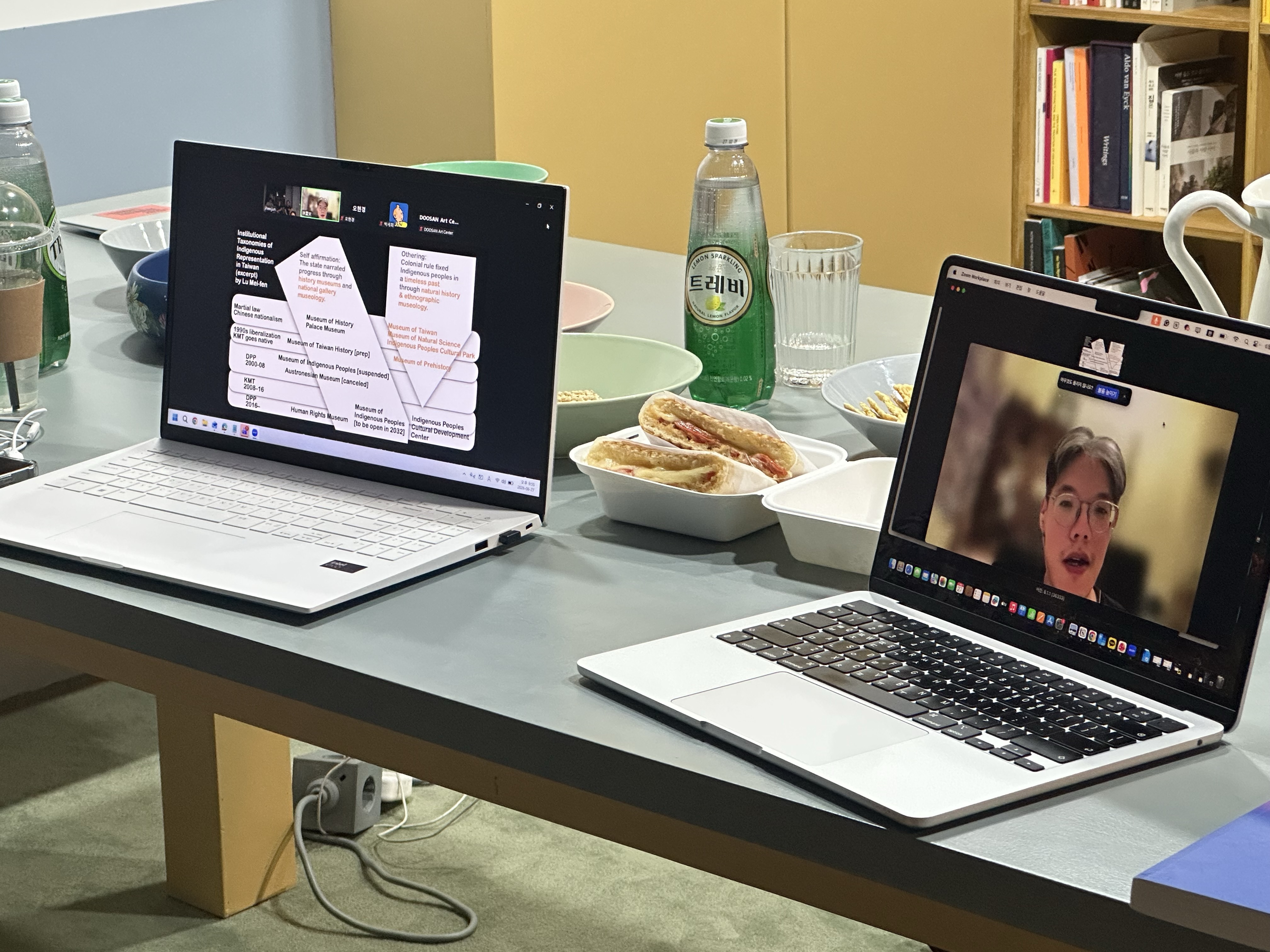
To prepare for the Taiwan field trip, we decided to hold two pre-study sessions. This included presentations by Hyun Kyung, Yujun, and Sejin on the trip’s themes of “the ocean,” “history,” and “institutions,” along with a Zoom meeting with Taiwan- and Shanghai-based editor Zian Chen, which provided an opportunity to hear about the contemporary Taiwanese art world landscape and related news and interests.
The presentations centering on “institutions” led us to research crucial moments from the history of Taiwan’s culture and art systems. We repeatedly saw how the culture and art systems of Korea and Taiwan had followed similar trajectories at similar tempos. Examples included the introduction of Western art and museum systems during the Japanese occupation; the establishment of museums, art institutions, and various committees with the aim of restoring and rebuilding a “national” quality after their liberation from Japanese rule; examples of support for authoritarian and patriarchal culture and art during long periods of dictatorship and martial law, as well as artistic resistance to these currents; outpourings of alternative experimentation following the achievement of democracy; leading roles for the central and local governments in nurturing cultural industries since the 2000s; and the opening of various large-scale regional culture institutions as part of that. The culture and art systems of the two countries have shared many similarities. One aspect that I found especially interesting was the brief renaissance of independent spaces, their successive closures, and the large-scale art museum construction projects that followed. In Korea, independent “alternative spaces” and “emerging spaces” have opened and closed, giving way to different kinds of experiments. When I consider the fact that the people shaping the Korean art ecosystem today are the same ones who encountered and were captivated by contemporary art at these spaces across different generations, I can easily imagine how similar things must have happened and be happening in Taiwan too. What became of the curators who were brought together by Taiwan’s independent spaces? What are they doing now and where? What implications do they hold for us in Korea?
Our encounter with Zian offered a first step toward answering these questions. He provided us with a thorough presentation on the historical context that we should understand for our three keywords, the institutions we should be looking at, and the major exhibitions that were going to be taking place during our visit. I had been at a loss as to how to prioritize things with all the different information and recommendations, so it was fortunate that his guidance allowed us to come up with a map of the topography of Taiwanese contemporary art (in both the literal and figurative senses). Even though our meeting took place at a late hour, he was willing to provide detailed answers to questions, including the ones that had come up in my preliminary research process (namely, how and where the managers of Taiwan’s past independent spaces were carrying on their curatorial practice). Looking back on it now that the visit is over, I definitely think the prior understanding he provided allowed me to engage in deeper and more immediate dialogue with the people I encountered.
Zian also shared his own opinions and concerns about developments and major issues in the Taiwanese contemporary art scene. He had particularly interesting views on things that centered on themes of indigenous people and immigrants. Listening to his pointed insights about the often-overlooked fact that Taiwanese people of Chinese descent like himself are immigrants, along with his concerns about how to approach taboo subjects, I found myself yearning for more active dialogue and exchange among curators in our countries. Those times spent sharing unanswered questions, concerns, and processes are the moments when the seeds are planted for more extensive future connections and cooperation (even if we don’t necessarily notice it at the time).
– Park Sejin (DCW 2026)
While I was preparing for the field trip, colleagues of mine asked me, “How were Taiwan and the Taiwanese people formed?” We read four texts that provided answers to this question.
Mainland and Sea (Choe Malsun, 2020): Under Kuomintang rule, the official historical narrative in Taiwan was oriented toward China. It was filled with anger toward the people occupying the land that had been taken from them, the land they needed to return to someday. But with movements such as indigenous literature, people since the 1970s have been focusing not just on anti-communist ideology but on the land and people as they existed then. They began referring to that land as bentu, or “mainland” (meaning Taiwan as the mainland, rather than the People’s Republic of China). At the same time, the Taiwanese also created a language directed at what lay outside of Taiwan. This was haiyang, or “the sea.” Rather than situating Taiwan at the end of the continent, they declared it to be the center of a broader network extending over the sea to connect it with Japan, Okinawa, the Philippines, Southeast Asia, and the Pacific Ocean. In other words, the “mainland” and “sea” became new ways for the people of Taiwan to declare their position and perspective in terms of literature, history, memory, and spatial perception and to explain their own independence.
The (Post-)Cold War Era in the Kinmen Islands and the Dilemma of Identity (Wu Chun-fang, 2019): When a community is formed, that often leads to borders being established outside that community. Wu Chun-fang’s text tells the story of a place located on that boundary: the Kinmen Islands. Politically, these islands are controlled by Taiwan, but geographically, they are close to the city of Xiamen in China’s Fujian Province. Xiamen is nearby; Taipei is somewhere distant. This position has created a constant dilemma for the people of the Kinmen Islands. Even after the end of the civil war between the nationalists and communists, Kinmen remained on the front lines of the Cold War. The islands were riddled with bunkers, barbed wire, landmines, and military roads. China continued shelling the territory through 1978, and the Taiwanese government did not lift martial law until 1992. For all that they have experienced over the years, the people of the Kinmen Islands have maintained the attitude that “Kinmen is neither Taiwan nor China. Kinmen is just Kinmen.” To them, calls for independence and calls for reunification are equally uncomfortable. In contrast with “mainland” Taiwan’s movements to create a nation based on shared experiences, the Kinmen Islands represent a space filled with the stories of those who envisioned living a different way along the boundary.
The Empire of Words and Colonial Language Politics (Ju Miae, 2025): When people talk about Taiwan, one question keeps coming up: Why do the Taiwanese like Japan so much? A search for the origins behind this phenomenon leads us to language. Japan instructed its colonial subjects to learn the national language (Japanese). This language education was a governing tactic meant to turn the people of a colonized state into “imperial citizens.” Interestingly, while Korea and Taiwan were colonized by Japan around the same time, their situations were rather different. In Korea, Japanese language education was enforced chiefly through short-term mechanisms such as training sessions. While things would shift with the issuance of the general mobilization order in the late 1930s, there was a strong sense of being bonded by their emotional identity as the Korean people, and traditional systems such as the seodang (village school) continued providing education to a number of people. In contrast, Japanese study sessions had already been institutionalized in Japan as early as the beginning of the 1930s, and the language made its way into people’s day-to-day lives through mechanisms such as ten-year plans for language promotion and designated “national language [Japanese] households.” As a result, statistics show that by the early 1940s, only 22% of Koreans spoke Japanese, compared to a rate of 57% in Taiwan.
“A Comparative Study of Exhibitions on the Colonial Experience at Korean and Taiwanese National History Museums” (Lee Jiyeon, 2026): The colonial experience remains present even after colonial rule has ended. The question of how to remember it and communicate it to people is a different issue, however. Korea’s museums describe the era of colonialism through a narrative of oppression, resistance, and eventual liberation. In contrast, the National Museum of Taiwan History does not portray the colonial era solely in terms of themes of “oppression” and “resistance.” It also presents examples of institutional changes brought about by Japanese rule, including ones relating to education, railways, urbanization, industrialization, and everyday life. This does not mean that colonial rule is whitewashed. For people in Taiwan, the year 1945 marked the end of rule by Imperial Japan, but it was also the start of a long period of iron-fisted rule by the Kuomintang. Given the experiences of the February 28 incident in 1947, the White Terror, and extended martial law, the people of Taiwan cannot simply view 1945 as a “liberation date.”
Rather than understanding Taiwan in terms of any one fixed identity, these four texts helped me see that I should view it as a place where different historical layers intersect in complex ways. The initial question of how Taiwan and its people were “formed” positioned Taiwan as existing in opposition to China, but the image of the Taiwanese that I sensed over the course of these readings was something heterogeneous and multilayered—a mixture of colonial linguistic experiences, the redefinition of colonial/postwar memory, “mainland” and “sea” discourse, and lives and interactions along the border.
I was also able to learn some unexpectedly interesting information from the dialogue with curator Zian Chen that served as the final session of the field trip preparation seminar. In the early part of his presentation, he shared Lu Mei-Fen’s research on “colonial contact history.” While the earlier readings had led me to understand Taiwan’s identity as something formed through multiple overlapping historical strata, Zian’s presentation showed that this multilayered nature was not something given equal representation in the narratives of the museum system. I was astounded to hear that indigenous Taiwanese people, rather than being included as actors in Taiwan’s history, had instead been represented “frozen in time” as preserved specimens at natural history and ethnography museums. This was fascinating in the way it made me consider who narrates the “multilayered” history and how and who remains confined to its periphery—but it also left me with a rather bitter aftertaste.
– Park Yujun (Park Sehee) (DCW 2026)
“The sea.”
Ahead of our Taiwan field trip, we held several preliminary meetings as three people whose fondness for research can sometimes border on the excessive. We ended up narrowing the major themes of the trip down to three areas: history, the sea, and institutions. In my case, I was very interested in the cultures and history of Asian islands connected by the Kuroshio Current. Sejin contemplated what it means to “cross the ocean” today during a visit to Venice, and Yujun has critically examined the ways that exhibitions institutionalize history. Through honest discussions over the points where our individual interests found common ground, it became relatively clear what stories we wanted to gain from Taiwan and what perspectives we wanted to draw upon.
Fittingly enough for three people who love presenting and studies, we each selected a theme to research ahead of the field trip. I took on the theme of “the sea,” beginning my study with Hamel’s Journey. That record tells the story of Hendrick Hamel, a sailor with the Dutch East India Company who was traveling from Taiwan to Japan when he ran into storms that sent him adrift to Jeju. The reason was that all three of those locations—his origin in Taiwan, his intended destination of Japan, and his unintended destination of Jeju—are Asian islands situated along the Kuroshio Current.
In my presentation, I focused in particular on examining how the Kuroshio Current had become a cultural backdrop and livelihood for the islands located along its corridor. I also compared the ways in which this rough current was ed and explained in a language of “shipwrecks” and “drifting” rather than one of “life” from the perspectives of the people who colonized the islands. After the presentation, Yujun shared some comments that will stick with me for a long time:
“It sounds like the current is a really important actor. It might be meaningful to consider actor theory from that perspective.”
The last study session before the field trip was a Zoom meeting with the Taiwan-based curator Zian Chen. This was an opportunity to see a topographical map of contemporary art before heading to Taiwan. We heard an honest account of the Taiwanese art world and the way that state-led art museum policies operate as strongly as in Korea, if not more so. The discussion also noted how stories about Taiwan’s indigenous population and their history as people who have experienced different forms of colonial rule are still approached mainly in the realm of natural history rather than that of art. This gave some sense of what position the Austronesian culture of Taiwan’s indigenous people—something I had briefly encountered in my preliminary research—holds both in contemporary Taiwanese society and in culture and the arts.
It was not until after the field trip that I realized how the research I had read about the “Green Island” name while preparing for my “sea” topic and the discussion of the Green Island Human Rights Art Festival that I heard about while meeting with Zian Chen were already giving a strong sense of the people we would encounter in Taiwan and the connections that would form among them.
Normally, I am accustomed to traveling overseas in a way where I disconnect almost entirely from any sense of movement, letting the airplane do all the work. My contemplation of “currents” while preparing for the field trip became a way of rediscovering a sense that I had largely forgotten. I regained an awareness of how human beings have long committed themselves to the oceans—sometimes trepidatiously, sometimes hopefully—in pursuit of a different place beyond their sphere of living. I understood the ocean in a new light, not simply as part of the scenery but as a force connecting different places and histories, facilitating or impeding movement and altering the course of people’s lives.
That may explain why the Pacific Ocean that I saw from Daping after arriving in Taiwan felt somehow different from the one I normally pictured.
– Oh Hyun Kyung (DCW 2026)