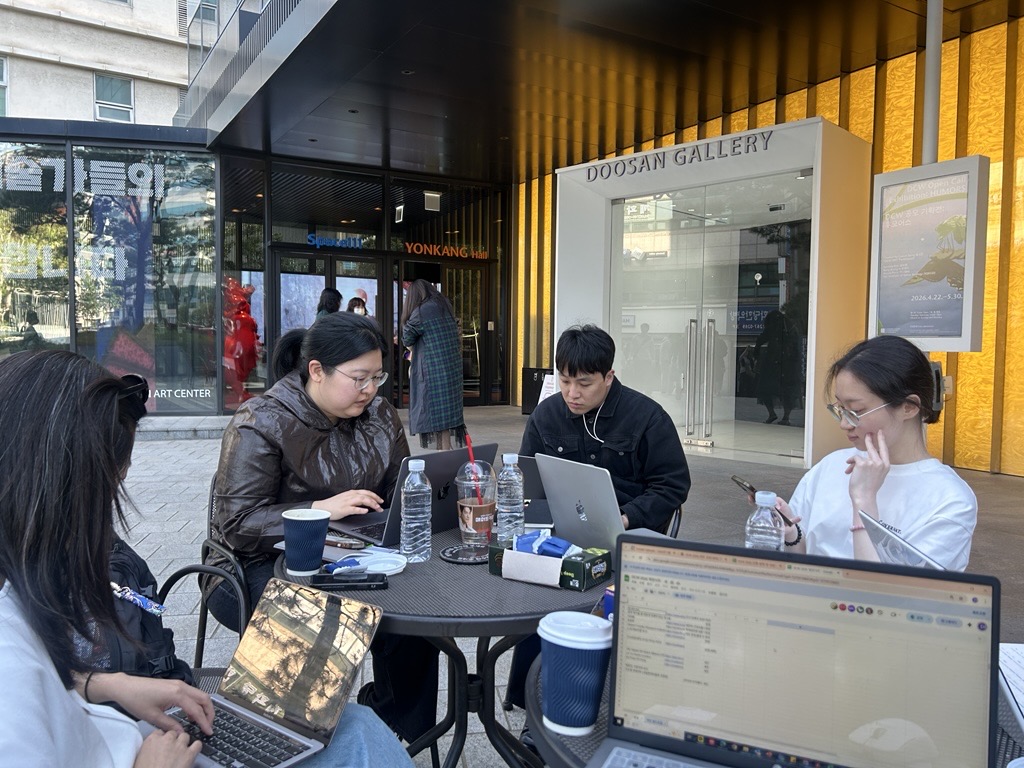
SeminarⅡ
The text we read, which was called “The Middleman: Beginning to Talk About Mediation” (Søren Andreasen & Lars Bang Larsen), examined the curator’s role from the perspective of “production.” What is it that the curator “produces” in art and how? The authors deliberately avoided the term “mediator,” which was widely used at the time (and remains so). Instead, they answer the question by way of Fernand Braudel’s concept of the “middleman.” In Braudel’s characterization, the middleman is someone who allows a “market” to take shape by transforming an object’s usage value into exchange value. They are also the only individual involved in the situation who understands the situation from both the producer’s and the consumer’s standpoints. An independent ontology for the middleman is not possible, as the middleman is someone who only emerges within a relationship of exchange and disappears once the transaction is complete. Due to the lack of transparency, the middleman can also be an object of distrust.
Curators represent the middleman of the system of global cultural capitalism. Simultaneously approaching issues that are metaphysical and highly concrete and practical, the curator mediates among the diverse layers that connect the artist, artwork, critic, and public. In that sense, they are not a “reacting” presence who responds to an existing artwork. In the words of Deleuze quoted in the text, they are figures who reproduce culture and explore change through a practice where they “put ideas into orbit and [. . .] get caught up in perpetual motion.”
I agree with the authors’ characterization of the curator as someone who sustains artistic production through “mediation” efforts that involve linking together a vast range of things through constant dialogue, writing, criticism, and interpretation. At the same time, I did not feel that the concept of the “middleman-curator” that they presented around two decades ago was sufficient to account for the situation faced by curators in the 2020s. Their text was published at a time of active discourse on the independent curator model amid a rapid proliferation of international biennials since the 1990s. Twenty years later, these same middlemen find themselves caught between a more sophisticated and rigidified market and a bureaucratic system, confronted with less room to maneuver and less influence as well as skepticism—from both themselves and from the outside—over a professional identity that remains ambiguous. It seems like the greater threat to the curator’s artistic production today is not the presence of an ontology that shifts it into a formal, fixed, and non-productive state and more an absence of ontology, which exhausts curators by sustaining and even intensifying the ambiguity, divisions, and instability they face.
I sensed similar concerns in my discussions with colleagues. Our conversation ranged from the insecure sense that “free middlemen are one false move away from becoming con artists” to the idealist belief that “anything can be discussed in art” and the more realistic prospect of becoming “someone opposed to the interests of the institution.” Others expressed dismay that the curator’s actions were “minimized” or “distorted” by the “middleman” term. It was also reported that similar questions came up as themes in the workshops last year and the year before, such as “What is the curator?” and “How does one become a curator?” This suggests that it remains difficult to discover one’s identity as a curator.
Most of all, I want to record some promising leads that emerged from the discussions: “Moving stories from the periphery to the center,” “listening and then speaking,” “presences who are trusted but not venerated,” and “creative labor.” I feel like this list of terms offers a vague picture of our changing times and image of the curator within them.
–Park Sejin (DCW 2026)
The text “The Middleman” by Søren Andreasen and Lars Bang Larsen reflects on the curator as a mediator who connects, translates, and negotiates relationships. This concept raises expectations with liberating language that transcends the boundaries of the establishment, including references to flexibility, mobility, and autopoiesis. This perspective would have been quite persuasive in the historical climate of Europe in the 1990s and 2000s, which saw an expansion of biennials, supranational art networks, and curatorial roles.
The curators living in Seoul in 2026 are experiencing a period where flexibility is giving way to instability, mobility to overwork, and autopoiesis to burnout. They are workers in a neoliberal culture: constantly connected, always adapting, and obliged to prove themselves both theoretically and practically (all while meeting their contracted dates). Think of the constant emails and subsidy applications, the complex approval systems, the unstable contracts, and the overwork. These elements are not something on the periphery of curating—they are the infrastructure that makes it possible.
So what meaning does it hold to read “The Middleman” today? Perhaps we can identify the differences between the time and place in which it was originally written and read—the optimism of European and American discourse between the late 20th and early 21st centuries—and the reality of cultural labor in 2026 and its chronic fatigue. That discrepancy leads us to think about how the discourse surrounding curating has changed and what questions we should be asking now.
–Park Yujun (Park Sehee) (DCW 2026)
[Curating Subjects: “The Middleman”—Reading Response]
In “The Middleman,” the role of the mediator or middleman appears to be central to curatorship. Curatorship is situated in a place where meanings are not fixed but ever-changing and where existing orders are disrupted and redefined. One particular interesting point about this text is that it explains the curator’s position by way of Rancière’s concept of politics. For Rancière, politics is not about confirming one’s place in an agreed-upon order. Rather, it is an event of misalignment that arises when the presences excluded or rendered unseen by that order come to the fore. From this perspective, a political presence can be seen as one that is not fully reducible to their given identity—one positioned in an intermediate state of non-sameness.
That is the position held by the curator. The curator is neither artist nor audience member; they are situated in between, organizing the conditions of the arranging, shifting, meeting, and clashing of meanings. The political identity of the curator emerges from that intermediate place. Rather than defining themselves in terms of one fixed identity, the curator maintains a state of non-sameness across different subjects, objects, systems, discourses, perceptions, and interpretations. The active role of the curator comes from the fissures of instability within that.
Yet there is also a question that arises here. The mediating nature of the curator is obviously a crucial condition of curatorship, but it also makes it difficult to define curating as a “profession.” Who exactly is the “professional” curator? What sort of things do they do? This is a question that emerged among the three of us in our meeting, and it has remained a subject of ongoing discussions since then. While I strongly agree with the idea that “the curator is not something; the curator does something,” I continue asking the question of whether it is really a good thing for there not to be a professional definition for people who continue making their living in that form of practice. Is there really “no ontology of the middleman”?
In this regard, the issue of specialization comes back to the fore. Is the role of curator a specialized job? Can only experts be curators? If not, why do so many curators invest so much time and money in gaining expertise? And if the curator does not have to be a professional, how do we account for all the things that are constantly demanded of them: knowledge, experience, networks, linguistics abilities, institutional understanding, and administrative know-how? At times, the discourse emphasizing the open and undefined nature of the curator seems to obscure the expertise the job actually demands, the intensity of the labor, and the minimal rules that need to be kept.
One thing that did become clearer after I read the text was the fact that the “middleman” nature of curating is both a political condition and a factor creating vulnerability. The fact that curating is not fully reducible to a fixed identity is something that allows curators to become active producers of meaning. Yet for the very same reason, the work they do is not assigned enough of a name or status. To gain that, a curator needs to be affiliated with an institution: an art museum, biennial, university, foundation, or administrative body. In other words, while the curator may be a middleman who critiques and reorganizes the system, they are also someone whose status is rendered unstable all too easily when they do not receive the institutional imprimatur. (At the same time, I also believe that fundamental vulnerability is the foundation of a political life.) The contradictory set of conditions surrounding curatorship seems to make it quite difficult indeed to become a “free middleman.” Is it possible for us to acquire some different role/analogy/name?
– Oh Hyun Kyung (DCW 2026)