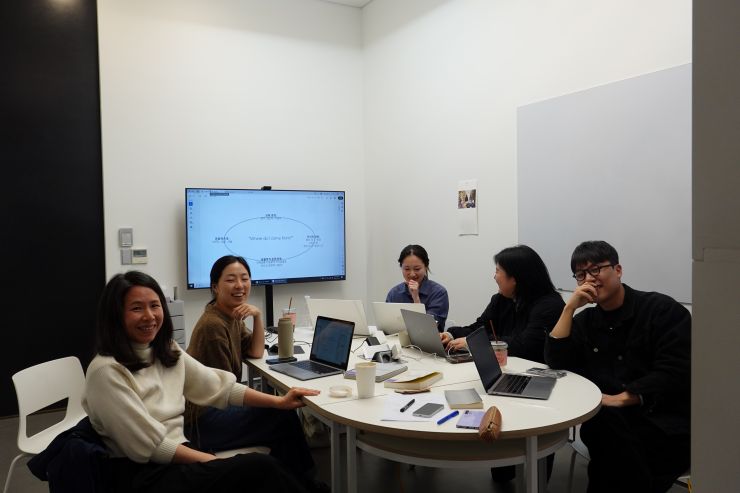
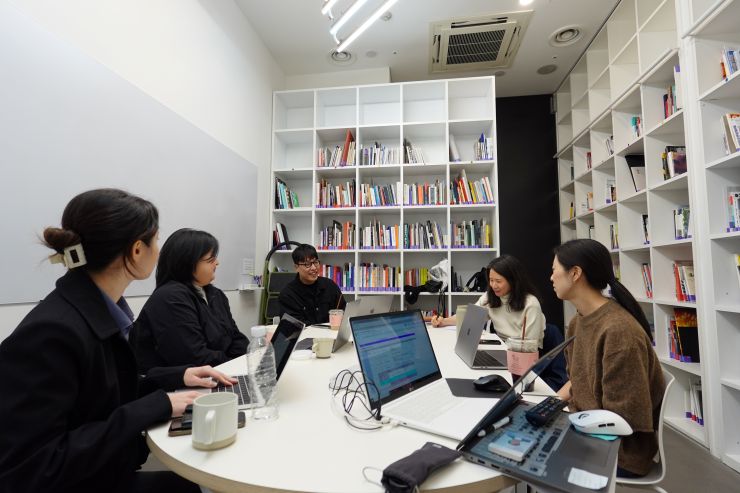
Seminar I - Binna Choi
Where do I come from? (My journey toward becoming a curator)
In my preparations to answer the question, “Where do you come from?” I often discovered new connections between experiences from my own journey and other experiences. These were encounters with people, events, and ideas whose significance I only recognized upon looking back after the passage of some time. Like gently breaking waves that alter the coastline over the years, those encounters had gradually led me to where I am now. Those forces were also at work on the pathways of the people who will be my colleagues for the next year. I found myself absorbed by individual stories as diverse as our current interests and activities. Will this year’s encounters become another driving force pushing and pulling all of us in certain directions?
All the different stories also reflected another force, one that has been profoundly influential on all of us and continues to affect us even now. This is the captivating force of art. It is an experience of something that pulls us to view, experience, and comment on the world and life in different ways. Perhaps a curator can be described as someone who creates resonance out of constant variations on the dynamic that this encounter stirs up in each of us. How can all of us guide the things we experience and discover through the encounters and entanglements of DCW in ways that effectively resonate and ripple in space and over the earth? I started out with a sense of both uncertainty and expectation.
– Park Sejin (DCW 2026)
Before the opening of the 2012 Busan Biennale (on the theme Garden of Learning), the exhibition director Roger M. Buergel convened a Learning Council made up of Busan residents. As a third-year high school student at the time (and one who did not really know what art even was), I took part in the gathering. I spent a full year working on the exhibition alongside fellow residents, artists, curators, and members of the Biennale’s organizing committee, and it was this experience that led me to choose a career in art—something I had never before considered. Fourteen years have passed since then, and my profession now involves creating exhibitions (even if I still don’t really know what art is). I also find myself wrestling the question of how I might do my job better. Some of my questions are about concerns that are quite essential (and thus even more difficult to answer). Why do I do this kind of work? What mindsets inform other people’s approach to this line of work? I hope that my year with DCW will be a journey of finding the best, most convincing answers to these questions that are possible at present—even if that turns out to be a long and difficult maze of a journey.
– Park Yujun (Park Sehee, DCW 2026)
“Where do you come from?”
The answer to this question may sometimes be a nationality, a city, a set of coordinates, a personal experience or history, or even a biological category. When I saw the sentences that represented the first question of the 2026 DCW—“Where do you come from?”—I had no idea how to answer. I felt like a navigator or astrologer trying to fathom the faint connections among stars in the night sky, or perhaps a shepherd suffering from insomnia. As I tried to come up with an answer with some clear sense of cause-and-effect—“This or that goal and experience led me to become a curator”—all it did was give me a new sense of how many different relationships and encounters have been present on my journey so far. The more I considered the question, the more I found myself swept up in the currents of more complicated connections. The method I finally chose was simply to show the complex constellation as I see it now.
It was only when Choi Binna explained to us that the sentence in question came from a greeting shared by native Hawaiians that the outline came into focus a bit more. It wasn’t meant to delve into anyone’s identity—it was something you asked to better understand the person you just met.
As we all shared our responses, we gradually gained a sense of the place where we stand together today. The method we used—each in our own way—was not so much to define ourselves as something but to share and explore where we were meeting each other within our individual, fluid processes of change. Sejin described herself as being at the point on a river where the upper course waters converge on the middle course. Yujun shared an experience of starting with a crucial school experience that led to his current research. Finally, there was me, sketching an incoherent diagram of the different definitions (or mistakes) that make me who I am. Listening to the other stories, I gained a clearer sense of being someone whose path now brushes with their present. Just as the many encounters and relationships that go into an exhibition transform the event itself and the people involved in it, our group now finds itself in the same kind of flow.
– Oh Hyun Kyung (DCW 2026)