

Perspective Strikes Back
2009
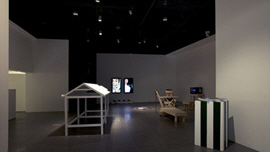
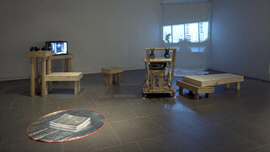
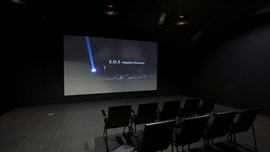
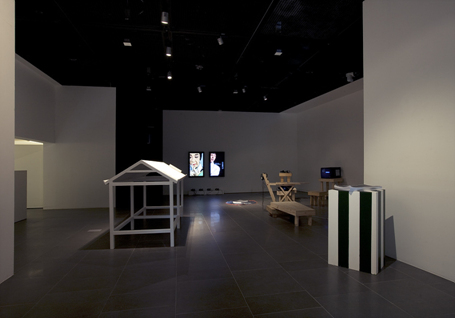
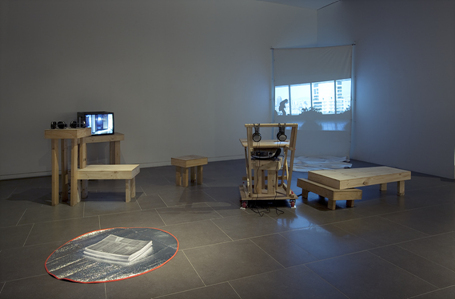
Installation view
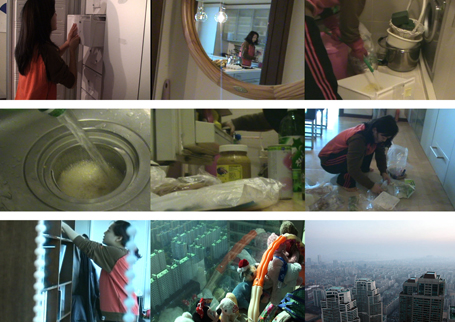
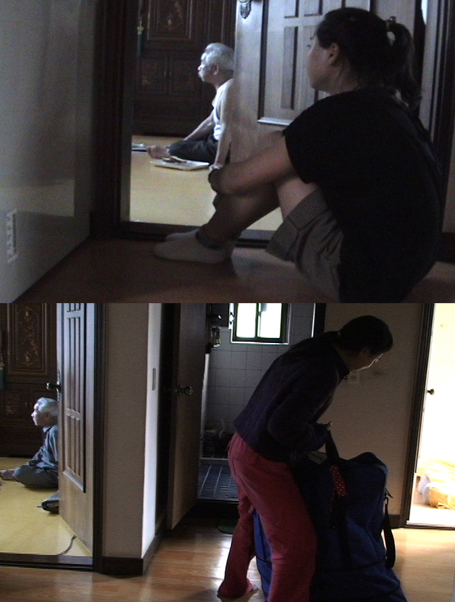
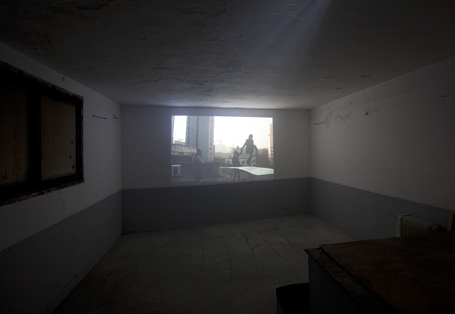

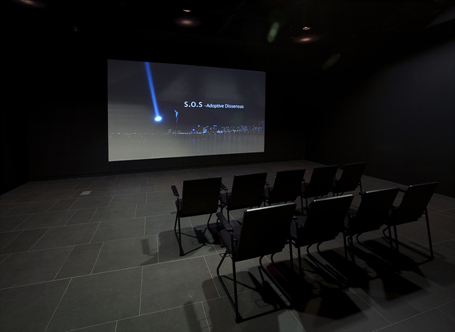
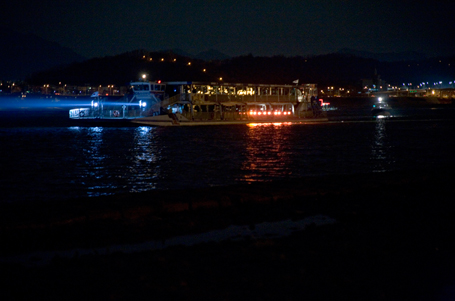

The Perspective Strikes Back exhibition reconstitutes the modern, contemporary scene through the eye of others inside our society, critically reconsidering the developer growth myth that has continued in Korean society until today. The curation was inspired by artist Minouk Lim’s SOS performance, which helped rediscover the constructed landscape on the banks of the Han River and the modern version of vanities, as well as Okwui Enwezor’s notion of andromodernity defining the developmental modernity of East Asian countries.
The history of Korean-style development, often referred to as the Miracle on the Han River, constitutes the strong foundations of current mainstream society. According to curator Okwui Enwezor, in his article Modernity and Postcolonial Ambivalence (Altermodern catalog, Tate, London 2009), Korean modernization is a typical example of developing modernity through adoption of the Western model of modernization (supermodernity), which is considered the sole category of the developed and advanced. He designates this developing modernity as andromodernity, meaning that it is a hybrid form of modernity, found especially in countries like China, India and South Korea. Such modernity is achieved through a kind of accelerated development, while also devising alternative models of development. It is understood to embody very masculine traits,
Since its principal emphasis is on development or modernisation. In most East Asian countries, it has been reinforced through the incorporation of heavy patriarchal tradition. Thus, it should be noted that the narrative of the Korean mainstream is quite centered on heterosexuality, masculism, and familism.
With the desire of the Faustian or pseudo-Faustian developer, society is rushing from the condensed growth model of the past to today’s ‘Green Growth’ plan, a more evolved form. It is simultaneously and constantly reproducing various invisible beings who has been drifted from the Korean developer’s march. The exhibition pays attention to certain kinds of social derelicts or the struggles of various non-mainstream individuals, attempting to reinterpret them as narratives of new possibility. It does not just aim to report the problems of the present national situation under Korea’s new government, but also deals with the marginalized narratives that constantly deviate from those of the solid Korean mainstream. In particular, by applying feminist perspectives to these issues, it explores the complex constitution of gender inside society and the ramifications of its representations, showing the perspectives of younger generation women who tries to re-establish themselves out of all kinds of violence or patriarchal conflicts.
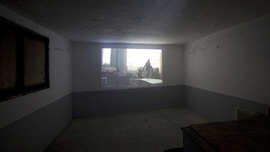
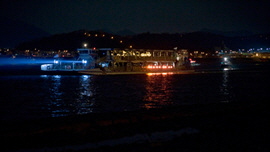
First, Minouk Lim’s film entitled SOS-Adoptive Dissensus (2009) ed the performance to take a cruise down the Han River in May, 2009, disclosing social issues in Korea including Pal-Sib-Pal-Man-Won-Se-De (880-thousand-won generation)’ and the issue of Bi-Jeon-Hyang-Jang-Ki-Soo (unconverted political prisoners) over the landscape of another construction project called “Han River Renaissance.” Through this 44-minute long single-channel video, the audience will follow the captain’s announcement and finally come to find the three different beings on the river bank: young people who are demonstrating, reflecting the light with mirrors, unsettled young lovers who are running along the bank of Nodeul Island, uncertain where to go, and the long-time political prisoners who are victims of the binary ‘security’ discourse under the North-South ideological conflict like cold war. In this way, we encounter not only contemporary scenes produced by modern Korea but also the vanitas of the growth myth in the flickering lights of the row of apartments by the riverside, recognizing that this persistent desire of developmental growth nevertheless reappears endlessly with changed faces.
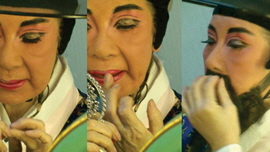
Artist siren eun young jung’s three video works, The Masquerading Moments (2009), The Unexpected Response (2009) and The Rehearsal (2009) feature female performers of Yeosung gukgeuk (women’s Korean musical) who play male characters. Yeosung gukgeuk started in the late 1940s as a new type of changgeuk (Korean traditional musical). Although the strong popularity it enjoyed during the 50s and 60s has faded away nowadays, it still possesses a very singular quality of subversiveness and queerness, derived from only female actors’ play that covers characters of all different ages as well as both genders (male/female). The artist took their bodily gestures, found on and off stage – that is, their performances – observing their equivocal, complicated gender representations. By capturing the irony whereby these actresses actively embody and appropriate Korean modern masculinity – like typical Korean macho men’s behaviour – the artist corroborates that modernity is still on the progress through more complexity of gender representation and its complicated performances of identity formation.
On the other hand, Ikjung Cho, Hyangro Yoon, and a collective, Part-time Suite, belong to the so-called Pal-Sib-Pal-Man-Won-Se-De (880-thousand-won generation) artists, mostly in their mid-late 20s, who have just graduated from college and must then compete to survive survive in this economic recession and era of unemployment. These artists’ works began with their perspectives on society and domesticity, conflicts and struggles relating to own concerns about the ground of their creations and diverse matters of life.
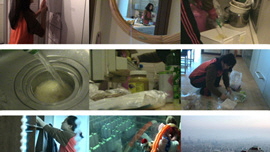
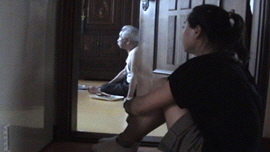
Cho presents the film, Four Refrigerator (2009), saying in an aside about her troubles with the men closest to her- for example, a patriarchal conflict with her father and an estrangement between her boyfriend and herself because of the class gap and the man’s complex. The second video by Cho, Room for Two (2009), is a fictional ary that tells a story about a woman involved in an uncomfortable and awkward relationship with an old man living alone for the purpose of finding a place where she would be able to spend time together with her financially inadequate young couple. Both of these show the weird and subtle relationship that a young woman has to form with different men in different positions in the social hierarchy, class level and generational strata, in order to obtain her own place and status.
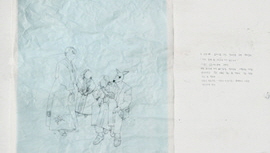
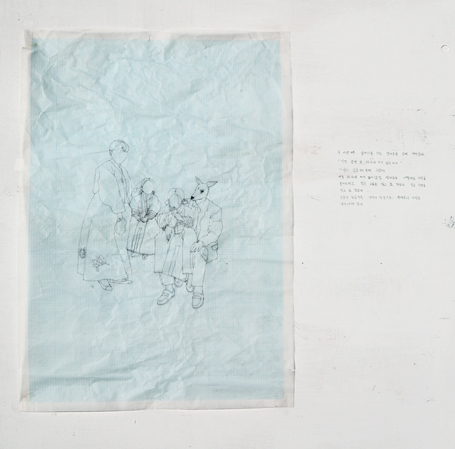
Hyangro Yoon’s drawings like The Secret Series (2008) and Criminal Lovers (2008), infused in a delicate and strange atmosphere, suggest the suppression imposed on and experienced by women in and outside the home, or sexual harassment to which children and women are exposed. Through the process of appropriating images from various kinds of old design books and modifying them, the artist moderates the expressive nature of drawing and creates some sense of distance and objectivity. This cold neutralization of images objectifies an individual’s particular experience or trauma, extending it to social level. It also persuades the audience to recognize how intensively the violence in social units such as the school and home is internalized.
Part-time Suite, who rent vacant spaces in urban areas for a month and create their own creative spaces, take a contrarian’s approach and fling off the passive resignation that younger artists can enter the art world only by being selected. They not only constantly look for and entirely occupy urban transitory spaces but also present the language of the new generation through their lyrical and beautiful installations and performances. After their two projects during the past six months, Under Interior (in the basement of a building in Ahyeon-dong, Seoul) and Off-Off-Stage (in an unoccupied plot hidden near Gwanghwamun), they are going to show their third space and project, Loop the Loop: viewers should leave from Doosan Gallery with maps in their hands and go to Part-time Suite’s space in the roof of an old building nearby. This group of artists is converting the feeble position of youths drifting away, feeling stunned and bewildered by the possibility of creative life, and in this very sense, they are themselves a sign of hope in today’s Korea.
The works of this exhibition disclose the reflective areas which can be drawn out of the drifting lives in society, and give an opportunity to consider the ambivalent and contradictory attributes of contemporary modernity that are still under formation through the tensions of different regional conditions in our global era. They also achieve an interesting complexity of gender formation that sublates traditional gender hierarchy influenced by domestic civil progress. Accordingly, this exhibition attempts to shed light on how the present of our society will be able to be reorganized and what complex process of modernity or contemporaneity found in the manifestation of the now-invisible subjects are undergoing. And what is required now is the search for ways to counterattack and reverse the ‘possible presents’ that is, a ‘future to come’ for us by discovering the many-sided being. The position of excluded individuals and their different viewpoints are strikes back to recently rebooting monotonous legacy of “development and growth” nowadays. Now we meet the hidden adversaries who produce antagonistic narratives against the monstrosity of our society. The value of inoperativeness now resonates here, while irregular perspectives reconstitute another modernity to come.